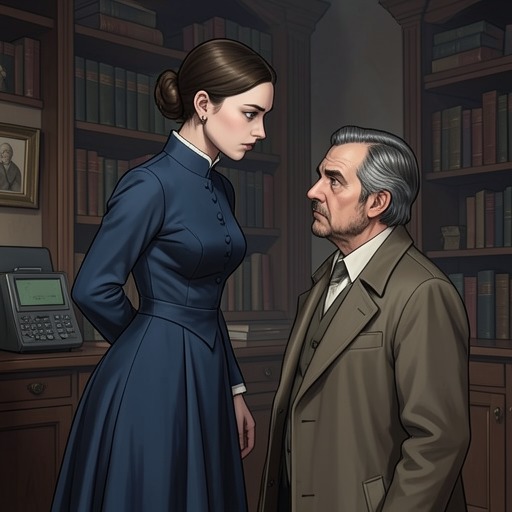
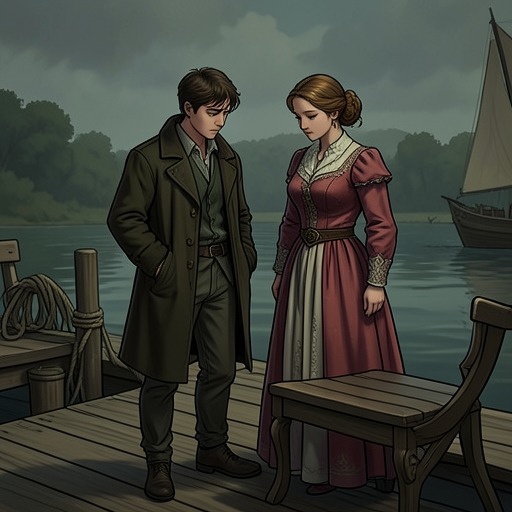
Pip escorts Estella to Richmond
Great ExpectationsPip escorts Estella to Richmond when she comes to London on Miss Havisham’s instructions. Their ten-mile journey marks a change in their circumstances, not a mutual movement toward intimacy: Estella is leaving the neighborhood where she has lived, while Pip remains absorbed by his unreturned love and interprets her attention through his hopes. Her departure for a new household makes those hopes more vivid even as the encounter confirms how little control he has over the relationship.
The Invitation and Its Terms
Pip learns of Estella’s arrival through a brief note saying that she will reach London by the midday coach and that Miss Havisham expects him to meet her. The note’s directness throws him into a flutter before he has even seen Estella; he recognizes the handwriting and anticipates her visit with intense excitement. The arrangement is Miss Havisham’s, and Estella writes that she is complying with it rather than presenting the meeting as a choice made for Pip’s sake.
When they meet, Estella appears more delicately beautiful to Pip than ever before, and her manner seems more winning than he remembers. He attributes the change to Miss Havisham’s influence. Once her luggage has been collected, he realizes that he does not even know where she is going. Estella tells him she is bound for Richmond in Surrey, ten miles away, and that he is to take her there by carriage. She gives him her purse to pay the expenses, presenting the escort as another instruction they must obey rather than a private excursion they have chosen together.
The Journey and Estella’s New Life
Estella explains that she will live at considerable expense with a lady in Richmond, who says she can take her about, introduce her, and show her to other people. The description frames her move as an entry into a new social world, one organized around being presented and seen. Pip accompanies her into that future but is not its purpose: Estella’s plans concern her residence and social introductions, while his attention fixes on the possibility of being near her.
As they travel, Estella makes clear that Miss Havisham’s plans continue to govern her movements. She says she must write to Miss Havisham regularly and report on her progress, adding that the jewels are nearly all hers. It is also the first time she has addressed Pip by name. The narration stresses that she does so deliberately and knows he will treasure the moment. The name feels intimate to Pip, but the deliberate nature of the gesture complicates that intimacy: Estella understands its emotional effect without offering a corresponding declaration of feeling.
The pair reach a house by Richmond Green, an old, formal residence associated with an earlier social world. Ancient trees in front of it have been cut into artificial shapes, and the setting’s worn grandeur places Estella’s new life amid inherited conventions and appearances. Two maids receive her; her boxes pass through the doorway, and Estella follows after giving Pip her hand and a smile and saying good night. The brief leave-taking closes the escort without resolving what Pip feels or what Estella feels toward him.
Attention Without Reciprocity
During the journey, Pip sees that Estella wants to attract him and is making an effort to be winning. Yet her attentiveness does not comfort him. He believes she holds his heart in her hand by choice, and fears that she could crush it without feeling tenderness. The scene therefore separates the appearance of warmth from the reality of emotional reciprocity: Estella can draw him closer while remaining, in his view, indifferent to the pain his devotion exposes him to.
Estella also tells Pip that he may visit her and that he has already been mentioned to the family. The invitation gives him a continuing place in her new surroundings, but it remains framed as permission and arrangement, not as a commitment between them. When he asks whether Mr. Jaggers has any responsibility for her while she is in London, she emphatically denies it and offers no further explanation. Pip’s hopes consequently attach themselves to small openings—her changed manner, his invitation to visit, and her use of his name—while the broader circumstances keep their lives directed by other people’s decisions.
The Parting and Its Significance
After leaving Estella at the Richmond house, Pip imagines how happy he would be if he lived there with her. At the same time, he acknowledges that he has never been happy with her and has always been miserable. This contradiction gives the escort its emotional shape: arrival fulfills the practical purpose of taking Estella to her destination, but for Pip it intensifies the longing that makes closeness painful. He returns with a worsening heartache, envying a young couple he sees on his way back.
The episode develops Pip’s class-conscious romantic idealization without suggesting that Estella’s new residence fulfills his own aspirations. Estella is being introduced into society under Miss Havisham’s plan, and Pip is assigned the role of escort; he can transport her to the threshold but cannot turn the journey into a reciprocal choice. In the wider arc of his story, that difference matters: his early belief that advancement and proximity might bring happiness is repeatedly unsettled, and the later close of the novel offers a different note. When Pip and Estella meet again at the ruined grounds of Satis House, they part as friends, and the evening mists rise without, in Pip’s perception, the shadow of another parting. That later reconciliation does not erase the unhappiness of the Richmond journey; it places his youthful longing within a longer movement from idealization toward a more restrained relationship.